

Biophysics Facility

Biophysics is the branch of science that deals with the application of physical principles and methods to solve various biological problems. Biophysics has contributed to the tremendous progress in the field of biomedical research, starting from the revelation of the DNA structure to the solving of mysteries behind how various proteins work. It demonstrated that variations in proteins are responsible for differential response to drugs. Understanding these differences opens new possibilities in drug design, diagnosis, and disease control.
ACTREC has been providing various services for basic research purposes. Biophysics Facility is one of the new services to be extended by ACTREC. Circular Dichroism (CD) and Fluorescence Spectroscopy are the two biophysical techniques from this facility and will be available for other institutes and industry for research purposes.
CD Spectropolarimeter JASCO J-1500
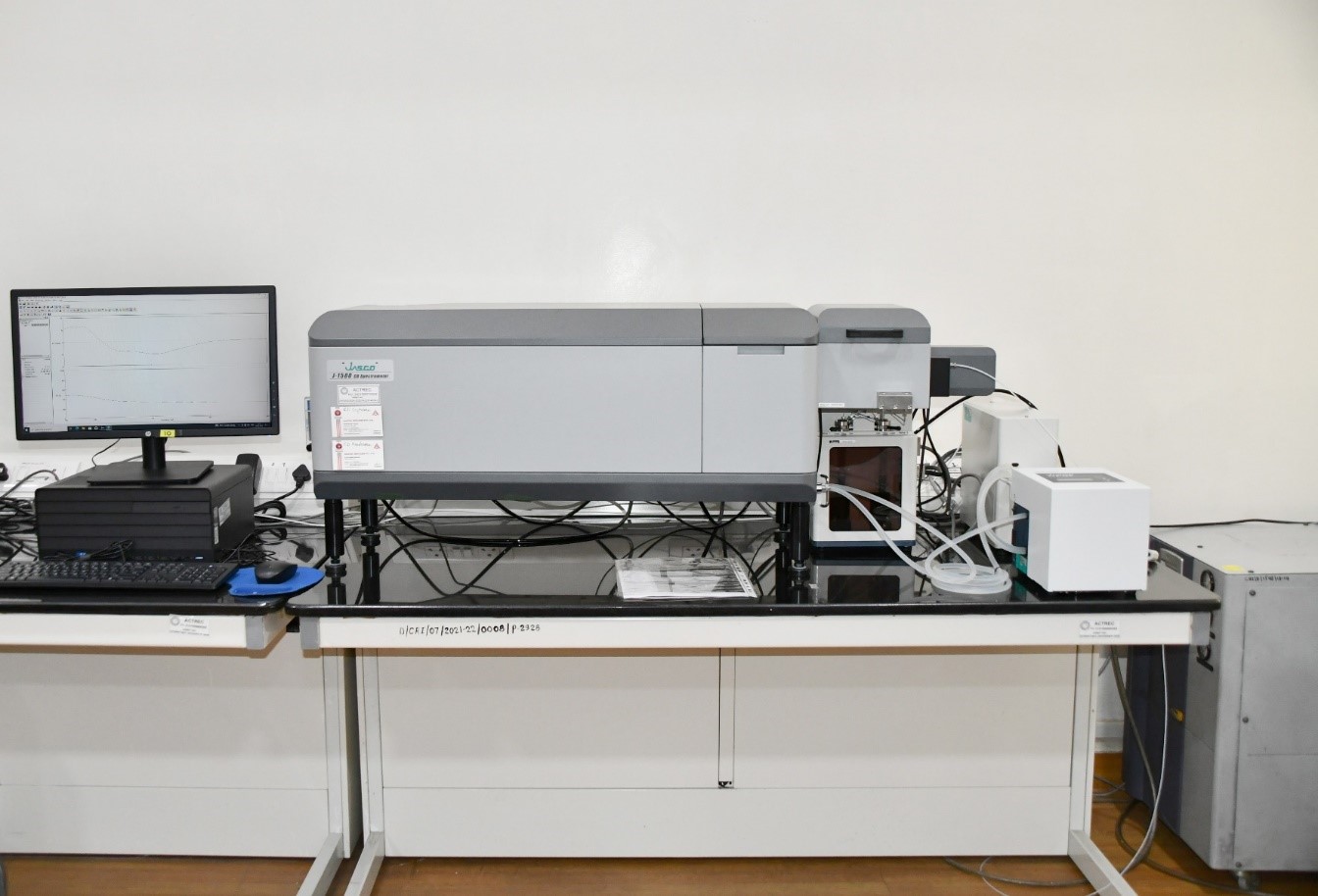
JASCO J-1500 Series offers highest performance with a broad range of accessories for maximum flexibility to meet complex research demands. It featured with spectral range (163 – 1600 nm), rapid scan capability, and standard PMT detector processing ensure excellent signal-to-noise and reproducibility. It supports Temperature control systems, coupled with multi-channel cells, can be used with CD instruments to gradually heat or cool samples and study temperature-dependent studies. Kinetic and protein dynamics studies can be performed with our dedicated stopped-flow systems. Comprehensive control and analysis are provided via Spectra Manager V.2 software.
Main Applications
- Protein secondary and tertiary structure analysis
- Protein folding and unfolding
- Thermal denaturation studies
- Protein-ligand interactions
- Peptide and small molecule studies
- DNA and RNA studies
NanoDSF (nano-Differential Scanning Fluorimetry) Prometheus NT.48
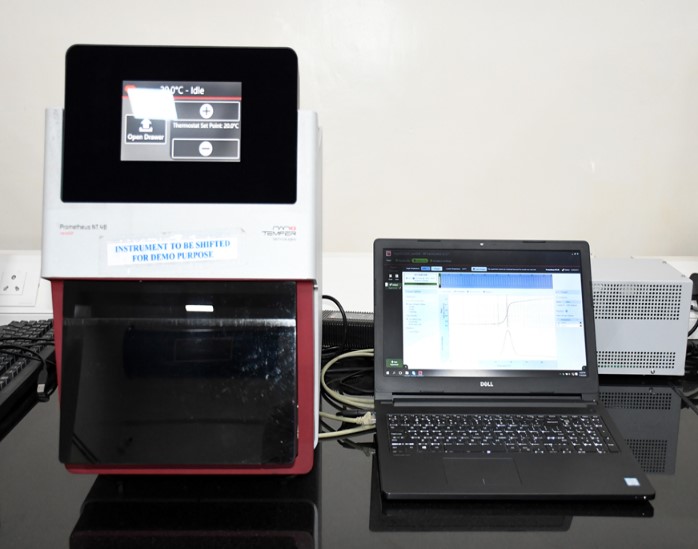
The Prometheus NT.48 is a high-throughput nanoDSF (nano Differential Scanning Fluorimetry) platform engineered for precise, label-free biophysical characterization of protein conformational stability and aggregation. Utilizing intrinsic tryptophan and tyrosine fluorescence at 330 nm and 350 nm, the system monitors thermal and chemical unfolding with ultra-high resolution, enabling detection of even minute structural transitions without the need for extrinsic dyes or labels. The instrument accommodates simultaneous analysis of up to 48 samples with minimal 10 µL sample volume and a wide dynamic concentration range (≈5 µg/mL to >150 mg/mL), facilitating stability profiling across diverse protein classes and formulation conditions. Controlled thermal ramps (e.g., 0.1–5°C/min over a broad temperature range) yield key stability parameters such as Tₘ, Cₘ/C50 and aggregation onset. Its high precision, rapid data acquisition and buffer-independent assay format make the Prometheus NT.48 as a powerful analytical platform for protein high-throughput screening in structural biology.
Main Applications
- Thermal stability analysis/ Melting temperature (Tm)
- Chemical stability / denaturation (Cm/C50)
- Protein unfolding and folding
- Protein–ligand interaction studies
- Formulation and buffer screening
- Determination of aggregation onset temperature (Tagg)
Octet RH16 Bio-Layer Interferometry (BLI) Sartorius
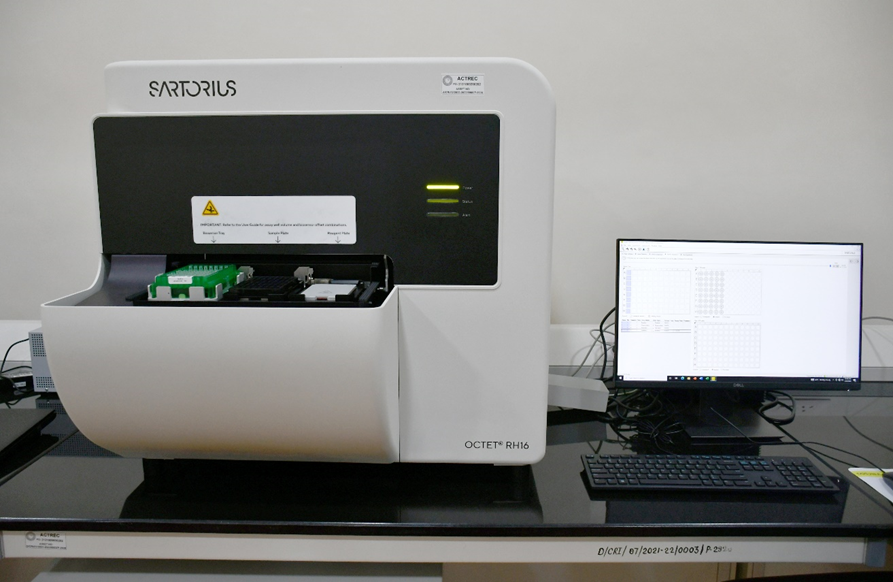
The Octet RH16 is a high-throughput Bio-Layer Interferometry (BLI) system engineered for real-time, label-free analysis of biomolecular interactions with simultaneous acquisition across 16 channels, enabling parallel processing of multiple samples with high sensitivity. Its fluidics-free, Dip-and-Read optical detection reduces assay complexity while supporting both 96-well and 384-well microplate formats for flexible experimental design. The platform delivers quantitative kinetic and affinity measurements (KD) over a broad range (1 mM to 10 pM) and is compatible with proteins, peptides, antibodies and complex matrices, with automation and robot integration. With robust assay performance, ambient to 40 °C control and comprehensive Software (Discovery Studio), facilitates high-capacity profiling of biomolecules. Hence supporting accelerated discovery, optimization and quality-control efforts in structural biology and biopharmaceutical research.
Main Applications
- Real-time, label-free analysis of bimolecular interactions
- Determination of binding kinetics and affinity (KD)
- Small molecule binding studies
- Antibody screening and characterization
- Epitope binning and epitope mapping
- Protein–DNA/RNA interaction studies
- Quantitation of proteins and antibodies in complex samples
HPLC for Size Exclusion Chromatography coupled with Multi angle Light Scatter (SEC-MALS) Waters Wyatt
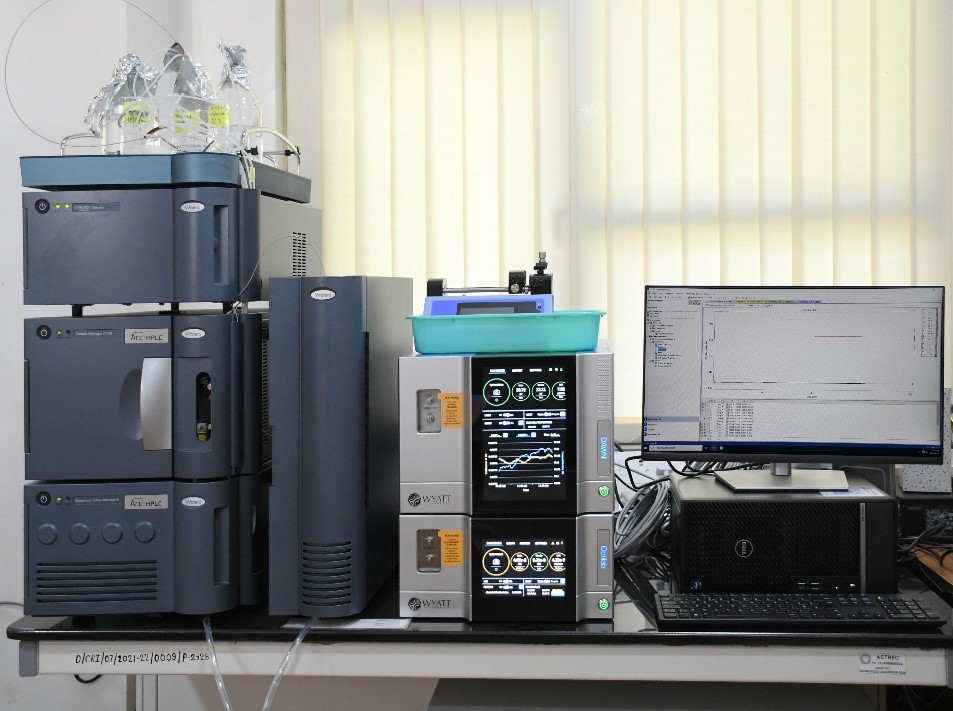
Our SEC-MALS platform combines the advanced chromatography capabilities of Arc HPLC with 2998 PDA Detector from Waters coupled with DAWN MALS and Optilab RI Detectors from Wyatt. The Arc HPLC enables reliable and reproducible size-exclusion chromatographic separation. The PDA detector provides UV-visible detection and spectral information from 190–800 nm. MALS determines absolute molecular weight and molecular size using multi-angle light scattering. The Optilab RI detector provides refractive-index and concentration measurements for suitable samples. Unlike conventional SEC, it does not depend mainly on molecular-weight standards. Data are integrated and analyzed using Wyatt ASTRA software for comprehensive molecular characterization.
Main Applications
- Absolute molecular weight determination
- Protein oligomerization / aggregation
- Determination of radius of gyration (Rg) about molecular shape/compactness.
- Protein–ligand or protein–DNA/RNA complexes
- Protein purity and heterogeneity
DynaPro NanoStar Wyatt
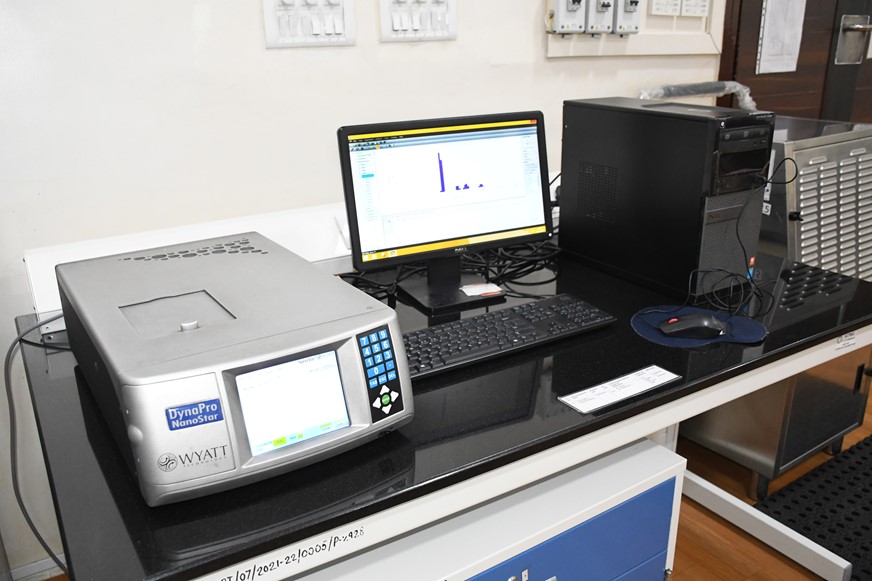
DynaPro NanoStar is a compact, cuvette-based Dynamic Light Scattering (DLS) and Static Light Scattering (SLS) instrument manufactured by Wyatt Technology. Combines a 90° DLS detection channel with a dedicated 90° SLS detection channel to simultaneously measures hydrodynamic radius/particle size (0.2 nm to 25,000 nm), absolute molar mass (via static light scattering), particle concentration, polydispersity, turbidity, and thermal stability. Features the DYNAMICS Touch screen interface for quick walk-up measurements, alongside the comprehensive DYNAMICS PC software for deep batch analysis.
Main Applications
- Hydrodynamic size measurement (Rh) of proteins, complexes and nanoparticles. Determination of absolute molar mass
- Detects, quantifies and monitors the presence of aggregates, monomers, dimers or other oligomeric states in protein and particle solutions
- Assesses structural integrity, folding/unfolding and stability changes.
| Sr. No. | Samples for Biophysics Facility | DAE units other than TMC (in ₹ per sample) | R&D and other Educational Institutions (in ₹ per sample) | Industry /Corporates (in ₹ per sample) |
|---|---|---|---|---|
| 1. | Circular dichroism for far and near UV spectra | 150 | 820 | 1600 |
| 2. | Circular dichroism for protein folding study (using chemical denaturant) | 750 | 1850 | 4500 |
| 3. | Circular dichroism for thermal denaturation study | 200 | 1200 | 2250 |
Please refer to the files presented in the hyperlinks for CD sample buffer preparation before preparing your samples.
Forms without incorporating the following detailed information will not be accepted-
- Protein/peptide concentration in µM.
- Buffer composition (should include exact composition of the buffer, the pH and the additives).
For an example,
Protein A = 15 µM
Buffer: 20 mM NaH2PO4/Na2HPO4, 100 mM NaCl, pH 7.2
How to submit the samples: Please fill up the relevant forms as per your requirement. For any queries regarding protocol, mode of payment and other specifications, please write to the facility, briefly describing your requirement.
Mode of Payment: Please make payment along with the samples. Payments are to be made only by crossed demand draft (DD). The DD must be drawn in favour of 'The Director, ACTREC' payable at 'Navi Mumbai'.
Kindly note that only on receipt of the payment along with the samples, they will be registered for analysis and taken up for measurement as per the queue of the users of the instrument concerned. As soon as the analysis is over, the spectra along with the receipt / bill will be sent to the users. Separate samples need to be sent for each experiment.
Prof. Kakoli Bose
PI, Bose Lab
ACTREC, Tata Memorial Centre
Kharghar, Navi Mumbai 410210
Ph: (022)68735109
Chairperson, Standing Academic Committee, ACTREC
External Member, Board of Studies, MS University Baroda, India
Faculty-in-charge: Biophysics Facility, ACTREC
Associate Editor, Bioscience Reports, Portland Press, UK
Member, Training Theme Panel, Biochemical Society & Royal Society of London, UK
E-mail: bpf[at]actrec[dot]gov[dot]in
Ms. Ulka Sawant
Facility-In-charge, Biophysics Facility
Advanced Centre for Treatment, Research & Education in Cancer (ACTREC)
Tata Memorial Centre
Room No. KS-156
Plot No.1 & 2, Sector 22
Kharghar, Navi Mumbai - 410 210
Ph: (022) 68735031
E-mail: bpf[at]actrec[dot]gov[dot]in